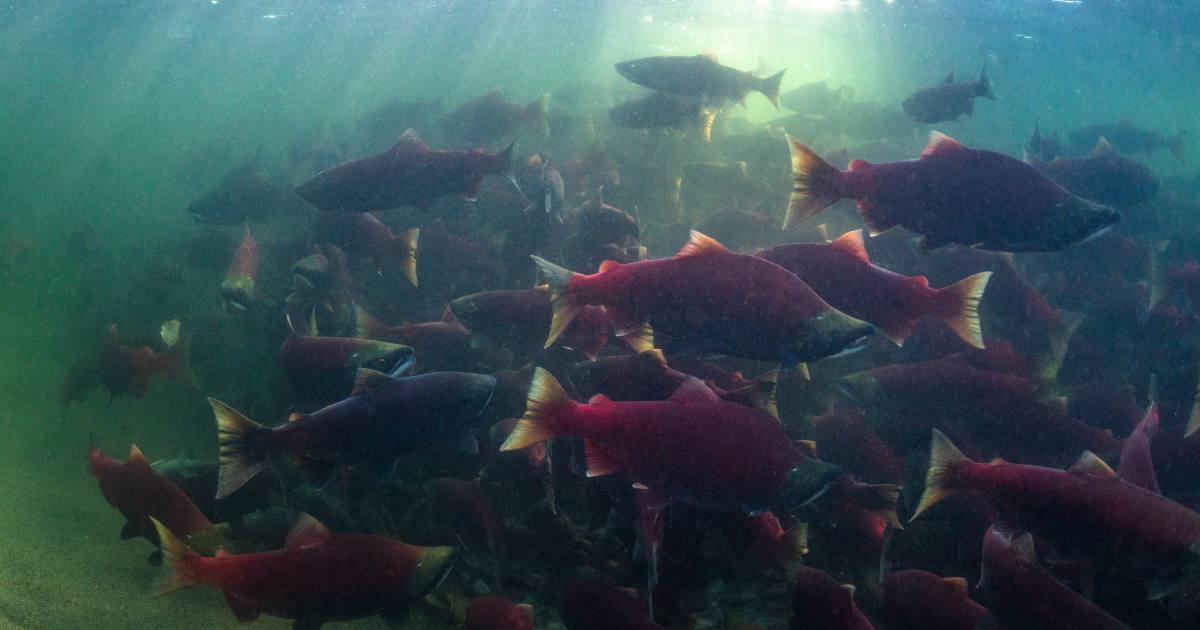
About 55 kilometres north of Campbell River, B.C., in a short mainland inlet called Phillips Arm, something interesting happened this summer.
Pink salmon returned in such high numbers that Fisheries and Oceans Canada (DFO) reported “significant abundance” in the Phillips River and surrounding waters, and opened limited commercial fisheries targeting the run. The catch was massive: over one million fish, worth roughly $9 million wholesale, in a year that was otherwise tough for B.C.’s commercial salmon fishers.
Why did so many pink salmon come back?
There is no simple answer. But looking at what has changed in and around the Phillips River and Phillips Arm over the past decade may offer some intriguing clues, and perhaps a hopeful glimpse of the way forward for other parts of B.C.’s coast.
Reducing marine and land pressures
Phillips Arm isn’t a pristine watershed suddenly producing salmon. The Kwiakah First Nation spent years studying the impacts of industrial activity, including logging, on their territory and working to change how the land is managed. The Nation negotiated lower timber harvest levels, less frequent harvesting and wider buffers around designated streams.
Now the Kwiakah are going much further. The Nation is pursuing regenerative forestry and building a conservation economy centred on stewardship, research and healing the land. Its forest keepers are monitoring and restoring previously logged areas, while researchers are studying how forests can regain characteristics of old-growth ecosystems.
In May 2024, after years of negotiation, that work produced something concrete. The Kwiakah signed an agreement with the Province and the forestry company Interfor to create the M̓ac̓inuxʷ Special Forest Management Area: 7,865 hectares along Phillips Arm. It is the ninth such area in the Great Bear Rainforest, and the Nation plans to expand the forest it protects to roughly 56,000 hectares by buying up other logging licences in its territory.
Another major change happened in the water. Phillips Arm once had a factory salmon farm inside the inlet, with numerous others scattered through the surrounding Discovery Islands waters. However, the factory farms were deemed a risk to wild salmon and were removed by the Minister of Fisheries after extensive consultations. We estimate, based on DFO’s public sea lice monitoring records, that the last fish were in the Phillips Arm farm in early 2021.
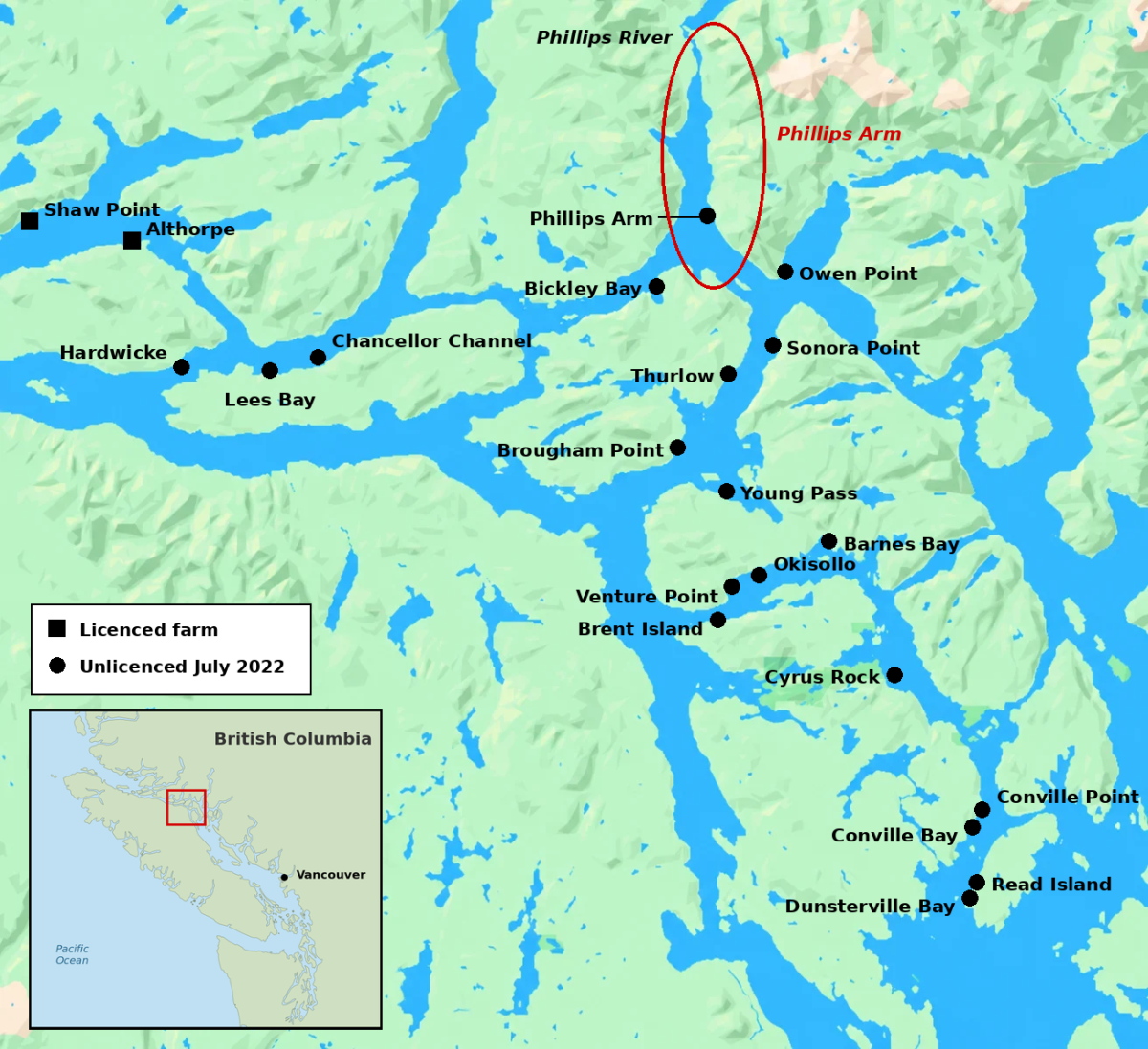
Phillips Arm (circled) and nearby salmon farm sites, with their licence status as of July 2022.
A large body of peer-reviewed evidence indicates that salmon farms can amplify parasites, viruses and bacteria and spread them to migrating juvenile wild salmon.
The pink salmon returning to Phillips Arm this year migrated to sea as tiny juveniles in spring 2025, years after the Atlantic salmon farms in the Discovery Islands had been removed. However, several farm sites are still active north of Phillips Arm.
Salmon survival is shaped by many factors, including freshwater habitat, ocean conditions, fishing and predators. Removing the farms may have eased one more: the pathogen pressure juvenile salmon face on their vulnerable migration to sea.
The Phillips Arm surge also fits a wider regional pattern of pink returns to B.C.’s mainland inlets that have been highly variable but trending upward overall in recent years. It has also coincided with a reduction in the mixed-stock commercial fisheries in Johnstone Strait that historically targeted Fraser River sockeye and swept up mainland-inlet-bound pinks along the way. Those Fraser sockeye fisheries have been increasingly closed or curtailed as Fraser sockeye returns have declined, thus easing another pressure on local pink salmon runs.
From a fish farm to a conservation economy
Perhaps the most interesting part of the Phillips Arm story is what is taking the place of the industries that once dominated the area.
Inside the management area, the Kwiakah are building a conservation economy based on restoring forests, stewardship and scientific research. The economics are meant to run the opposite way from the industries that came before: revenue from carbon credits, ecosystem services and research partnerships, earned by keeping the forest standing rather than cutting it down.
There is even a remarkable second life for the former Phillips Arm salmon farm. Kwiakah has repurposed its floating infrastructure as a Centre for Excellence, designed to support scientists, forest keepers and other stewardship staff working in the territory.
The last Kwiakah members left the village of Matsayno, at the head of Phillips Arm, in the 1930s. The Centre is anchored near those reserve lands, and when it opened it became the Nation’s first permanent presence in the territory in close to a century. They call it a return home.
The floating site has accommodation and a lab for up to sixteen scientists and stewardship staff, a float house for the Nation’s Guardian team, and a one-hectare kelp and seaweed test farm assembled from the former fish farm’s own docks and cages. Researchers from the University of British Columbia, the University of Victoria and the University of Calgary are already working alongside them.
That makes Phillips Arm particularly relevant as Canada moves toward its promise to remove the remaining open-net pen salmon farms from B.C. waters by June 2029.
There are legitimate questions about what that change will mean for workers, communities and coastal economies. Phillips Arm doesn’t provide all the answers, but it does offer an encouraging example of how removing one industrial use can be accompanied by something new: restoration, research, stewardship and economic opportunities built around healthier ecosystems.
We can’t say exactly why so many pink salmon came home to Phillips Arm this year, but this inlet may be showing us what becomes possible when we reduce pressures on wild salmon, remove factory salmon farms and restore damaged forests, and build economies around helping the land and water recover.
Share This Story!
About 55 kilometres north of Campbell River, B.C., in a short mainland inlet called Phillips Arm, something interesting happened this summer.
Pink salmon returned in such high numbers that Fisheries and Oceans Canada (DFO) reported “significant abundance” in the Phillips River and surrounding waters, and opened limited commercial fisheries targeting the run. The catch was massive: over one million fish, worth roughly $9 million wholesale, in a year that was otherwise tough for B.C.’s commercial salmon fishers.
Why did so many pink salmon come back?
There is no simple answer. But looking at what has changed in and around the Phillips River and Phillips Arm over the past decade may offer some intriguing clues, and perhaps a hopeful glimpse of the way forward for other parts of B.C.’s coast.
Reducing marine and land pressures
Phillips Arm isn’t a pristine watershed suddenly producing salmon. The Kwiakah First Nation spent years studying the impacts of industrial activity, including logging, on their territory and working to change how the land is managed. The Nation negotiated lower timber harvest levels, less frequent harvesting and wider buffers around designated streams.
Now the Kwiakah are going much further. The Nation is pursuing regenerative forestry and building a conservation economy centred on stewardship, research and healing the land. Its forest keepers are monitoring and restoring previously logged areas, while researchers are studying how forests can regain characteristics of old-growth ecosystems.
In May 2024, after years of negotiation, that work produced something concrete. The Kwiakah signed an agreement with the Province and the forestry company Interfor to create the M̓ac̓inuxʷ Special Forest Management Area: 7,865 hectares along Phillips Arm. It is the ninth such area in the Great Bear Rainforest, and the Nation plans to expand the forest it protects to roughly 56,000 hectares by buying up other logging licences in its territory.
Another major change happened in the water. Phillips Arm once had a factory salmon farm inside the inlet, with numerous others scattered through the surrounding Discovery Islands waters. However, the factory farms were deemed a risk to wild salmon and were removed by the Minister of Fisheries after extensive consultations. We estimate, based on DFO’s public sea lice monitoring records, that the last fish were in the Phillips Arm farm in early 2021.
Phillips Arm (circled) and nearby salmon farm sites, with their licence status as of July 2022.
A large body of peer-reviewed evidence indicates that salmon farms can amplify parasites, viruses and bacteria and spread them to migrating juvenile wild salmon.
The pink salmon returning to Phillips Arm this year migrated to sea as tiny juveniles in spring 2025, years after the Atlantic salmon farms in the Discovery Islands had been removed. However, several farm sites are still active north of Phillips Arm.
Salmon survival is shaped by many factors, including freshwater habitat, ocean conditions, fishing and predators. Removing the farms may have eased one more: the pathogen pressure juvenile salmon face on their vulnerable migration to sea.
The Phillips Arm surge also fits a wider regional pattern of pink returns to B.C.’s mainland inlets that have been highly variable but trending upward overall in recent years. It has also coincided with a reduction in the mixed-stock commercial fisheries in Johnstone Strait that historically targeted Fraser River sockeye and swept up mainland-inlet-bound pinks along the way. Those Fraser sockeye fisheries have been increasingly closed or curtailed as Fraser sockeye returns have declined, thus easing another pressure on local pink salmon runs.
From a fish farm to a conservation economy
Perhaps the most interesting part of the Phillips Arm story is what is taking the place of the industries that once dominated the area.
Inside the management area, the Kwiakah are building a conservation economy based on restoring forests, stewardship and scientific research. The economics are meant to run the opposite way from the industries that came before: revenue from carbon credits, ecosystem services and research partnerships, earned by keeping the forest standing rather than cutting it down.
There is even a remarkable second life for the former Phillips Arm salmon farm. Kwiakah has repurposed its floating infrastructure as a Centre for Excellence, designed to support scientists, forest keepers and other stewardship staff working in the territory.
The last Kwiakah members left the village of Matsayno, at the head of Phillips Arm, in the 1930s. The Centre is anchored near those reserve lands, and when it opened it became the Nation’s first permanent presence in the territory in close to a century. They call it a return home.
The floating site has accommodation and a lab for up to sixteen scientists and stewardship staff, a float house for the Nation’s Guardian team, and a one-hectare kelp and seaweed test farm assembled from the former fish farm’s own docks and cages. Researchers from the University of British Columbia, the University of Victoria and the University of Calgary are already working alongside them.
That makes Phillips Arm particularly relevant as Canada moves toward its promise to remove the remaining open-net pen salmon farms from B.C. waters by June 2029.
There are legitimate questions about what that change will mean for workers, communities and coastal economies. Phillips Arm doesn’t provide all the answers, but it does offer an encouraging example of how removing one industrial use can be accompanied by something new: restoration, research, stewardship and economic opportunities built around healthier ecosystems.
We can’t say exactly why so many pink salmon came home to Phillips Arm this year, but this inlet may be showing us what becomes possible when we reduce pressures on wild salmon, remove factory salmon farms and restore damaged forests, and build economies around helping the land and water recover.
Share This Story!