What’s Happening with Sockeye?
August 6, 2026
By: David Mills
Early-season dispatches from the Skeena and the Fraser suggest conservation concerns are rising–but that’s not stopping the Americans
Worrying information from the Skeena River, Fraser Panel reports, and test fisheries across the coast is indicating that some of Fisheries and Oceans Canada’s (DFO) preseason forecasts aren’t matching the returns. With budgetary and monitoring cuts already impacting oversight, and public accountability missing in action, it appears the ‘harvest first, then ask questions later’ approach to Pacific salmon fisheries management is back in fashion. Meanwhile, the Americans are using a broken Pacific Salmon Treaty to maximize their harvest of Canadian sockeye…with no obligation to report bycatch of non-target species like steelhead or chinook.
A strong start stutters on the mighty Skeena
Two problems are colliding on the Skeena and Nass.

Watershed Watch Fisheries Advisor David Mills
Biologically, our salmon are threatened by decades of harvest pressure and face rapidly shifting ocean conditions from climate change — precisely when precautionary management matters most. Structurally, the Pacific Salmon Treaty wasn’t built for this: a fair treaty would protect stocks of concern regardless of which side of the border they’re swimming on.
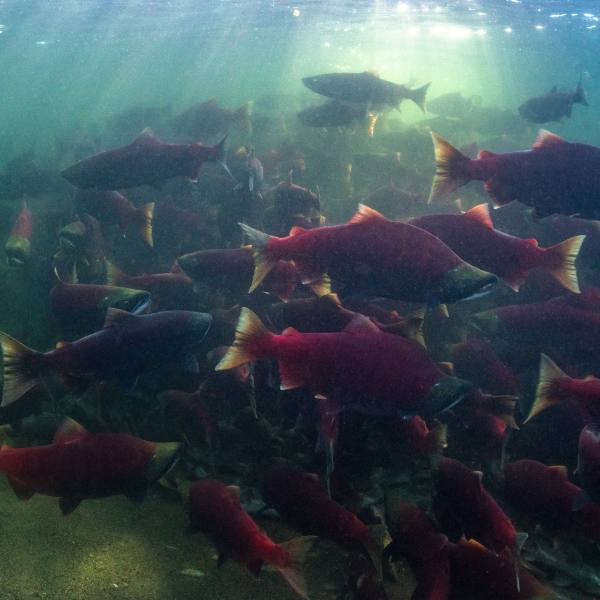
Sockeye Salmon. Tavish Campbell
This year’s return shows how that plays out. Skeena sockeye were forecast as high as 3.3 million, but a strong start pushed in-season models up to 4.4 million. So, after the July 10th opening DFO let commercial nets fish nearly every day in July. However, the early run was almost entirely 5-year-old fish — the expected 4-year-old component never showed. Despite rapidly shrinking projections and warnings from First Nations and other stakeholders, DFO didn’t close the fishery until August 2nd. If the final return slips below 2 million, Canadian harvest may already have exceeded what our own management plan allows.
The Americans are taking aim
But our management plan is only half the problem: the Treaty’s restrictions on American harvest expired July 31st. Even though District 104 off the southeast coast of Alaska is a long haul from Alaskan fuel docks and processors, the Southeast seine fleet is repositioning to take advantage of this stretch of the season with no restrictions on Canadian fish. We don’t yet know how many boats will fish, or what the impacts will be to later-timed sockeye or co-migrating steelhead, chinook, chum, and coho.
What we do know is that the Pacific Salmon Treaty needs urgent reform to ensure that when necessary conservation measures are applied, they’re applied to the population no matter where it’s swimming.
On the Fraser, migratory conditions are good, but the forecast is falling
Even though water temperatures and flow rates in the main stem of the Fraser are conducive to survival, commercial openings for Fraser sockeye in 2026 now depend on upcoming Summer and Late run assessments. Fraser River Panel presentations through August 4th reveal that returns to date are substantially underperforming relative to their pre-season forecasts. The Fraser River Panel is a creation of the Pacific Salmon Treaty. It meets weekly during the fishing season to chart the migration of Fraser sockeye. Its decisions on run size determine whether or not a harvestable surplus exists.
So far, it has determined that:
- The Early Stuart run finished its marine migration early. With an adopted size of 46,000, it’s significantly lower than the pre-season median forecast, though still within the lower probability range.
- The Early Summer run is currently showing the most significant deficit. A commercial opening for Early Summers was only expected to be considered at run sizes above roughly 606,000.
- The adopted run size of 200,000 is 17% of the pre-season forecast.
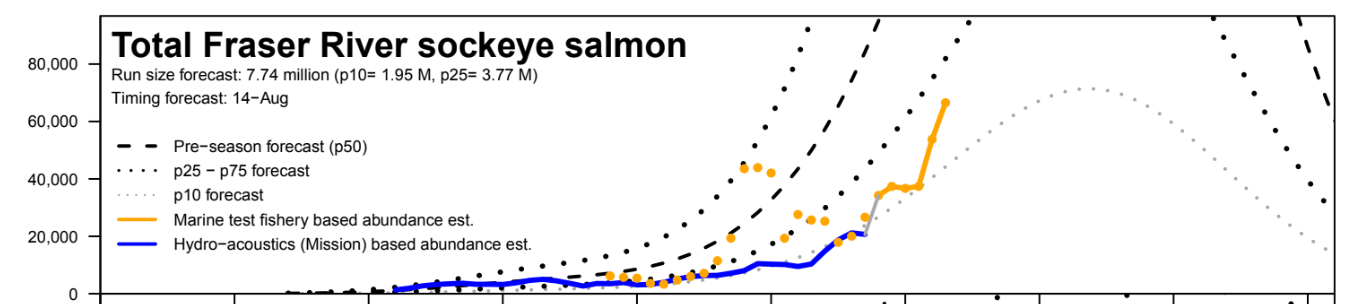
Marine test-fishery estimates (orange) are rising sharply, while hydroacoustic estimates at Mission (blue) remain much lower—showing the considerable uncertainty around this year’s Fraser sockeye return. The preseason median forecast was 7.74 million fish. Source: Pacific Salmon Commission.
Given the returns to date, it’s hard to imagine how the Summer and Late runs will come in with enough strength to allow for an opening. However, the pre-season forecast for both runs is still on the books.
What’s preventing an in-season run size adjustment for the summer run?
As of this week’s Fraser Panel meetings, the Summer run (pre-season forecast: 4,305,000) and the Late run (2,212,000) are both still being managed against their original pre-season forecasts — despite Early Stuart and Early Summer sockeye coming in well below what was predicted. Pacific Salmon Commission staff have made no recommendation to adjust either number downward. The longer those pre-season figures stay in place, the longer American fisheries can stage to capture Fraser sockeye passing through their waters on the final approach to the river.
As with Skeena fisheries, Americans are entitled to a portion of the Fraser run, depending on its abundance. And, as with the Skeena, these Treaty agreements built around fixed allocations and the calendar, rather than the actual condition of the stock, are proving to stymie conservation and prevent precautionary management — which is counter to the core vision of the Treaty: to cooperatively manage, conserve, and rebuild Pacific salmon stocks.

Fraser River
One species, two rivers, the same structural flaws. Learn more about the role the Pacific Salmon Treaty will play in our fishing future here.
Share This Story!
What’s Happening with Sockeye?
August 6, 2026
By: David Mills
Early-season dispatches from the Skeena and the Fraser suggest conservation concerns are rising–but that’s not stopping the Americans
Worrying information from the Skeena River, Fraser Panel reports, and test fisheries across the coast is indicating that some of Fisheries and Oceans Canada’s (DFO) preseason forecasts aren’t matching the returns. With budgetary and monitoring cuts already impacting oversight, and public accountability missing in action, it appears the ‘harvest first, then ask questions later’ approach to Pacific salmon fisheries management is back in fashion. Meanwhile, the Americans are using a broken Pacific Salmon Treaty to maximize their harvest of Canadian sockeye…with no obligation to report bycatch of non-target species like steelhead or chinook.
A strong start stutters on the mighty Skeena
Two problems are colliding on the Skeena and Nass.
Watershed Watch Fisheries Advisor David Mills
Biologically, our salmon are threatened by decades of harvest pressure and face rapidly shifting ocean conditions from climate change — precisely when precautionary management matters most. Structurally, the Pacific Salmon Treaty wasn’t built for this: a fair treaty would protect stocks of concern regardless of which side of the border they’re swimming on.
Sockeye Salmon. Tavish Campbell
This year’s return shows how that plays out. Skeena sockeye were forecast as high as 3.3 million, but a strong start pushed in-season models up to 4.4 million. So, after the July 10th opening DFO let commercial nets fish nearly every day in July. However, the early run was almost entirely 5-year-old fish — the expected 4-year-old component never showed. Despite rapidly shrinking projections and warnings from First Nations and other stakeholders, DFO didn’t close the fishery until August 2nd. If the final return slips below 2 million, Canadian harvest may already have exceeded what our own management plan allows.
The Americans are taking aim
But our management plan is only half the problem: the Treaty’s restrictions on American harvest expired July 31st. Even though District 104 off the southeast coast of Alaska is a long haul from Alaskan fuel docks and processors, the Southeast seine fleet is repositioning to take advantage of this stretch of the season with no restrictions on Canadian fish. We don’t yet know how many boats will fish, or what the impacts will be to later-timed sockeye or co-migrating steelhead, chinook, chum, and coho.
What we do know is that the Pacific Salmon Treaty needs urgent reform to ensure that when necessary conservation measures are applied, they’re applied to the population no matter where it’s swimming.
On the Fraser, migratory conditions are good, but the forecast is falling
Even though water temperatures and flow rates in the main stem of the Fraser are conducive to survival, commercial openings for Fraser sockeye in 2026 now depend on upcoming Summer and Late run assessments. Fraser River Panel presentations through August 4th reveal that returns to date are substantially underperforming relative to their pre-season forecasts. The Fraser River Panel is a creation of the Pacific Salmon Treaty. It meets weekly during the fishing season to chart the migration of Fraser sockeye. Its decisions on run size determine whether or not a harvestable surplus exists.
So far, it has determined that:
- The Early Stuart run finished its marine migration early. With an adopted size of 46,000, it’s significantly lower than the pre-season median forecast, though still within the lower probability range.
- The Early Summer run is currently showing the most significant deficit. A commercial opening for Early Summers was only expected to be considered at run sizes above roughly 606,000.
- The adopted run size of 200,000 is 17% of the pre-season forecast.
Marine test-fishery estimates (orange) are rising sharply, while hydroacoustic estimates at Mission (blue) remain much lower—showing the considerable uncertainty around this year’s Fraser sockeye return. The preseason median forecast was 7.74 million fish. Source: Pacific Salmon Commission.
Given the returns to date, it’s hard to imagine how the Summer and Late runs will come in with enough strength to allow for an opening. However, the pre-season forecast for both runs is still on the books.
What’s preventing an in-season run size adjustment for the summer run?
As of this week’s Fraser Panel meetings, the Summer run (pre-season forecast: 4,305,000) and the Late run (2,212,000) are both still being managed against their original pre-season forecasts — despite Early Stuart and Early Summer sockeye coming in well below what was predicted. Pacific Salmon Commission staff have made no recommendation to adjust either number downward. The longer those pre-season figures stay in place, the longer American fisheries can stage to capture Fraser sockeye passing through their waters on the final approach to the river.
As with Skeena fisheries, Americans are entitled to a portion of the Fraser run, depending on its abundance. And, as with the Skeena, these Treaty agreements built around fixed allocations and the calendar, rather than the actual condition of the stock, are proving to stymie conservation and prevent precautionary management — which is counter to the core vision of the Treaty: to cooperatively manage, conserve, and rebuild Pacific salmon stocks.
Fraser River
One species, two rivers, the same structural flaws. Learn more about the role the Pacific Salmon Treaty will play in our fishing future here.