It’s shaping up to be one of the strongest El Niño events ever recorded. Here’s what it means for B.C. salmon and how we manage them.
This past January, in the middle of a warm winter with insufficient snow in southern B.C., hundreds of people gathered online at the invitation of Canada’s Department of Fisheries and Oceans (DFO) to hear the annual salmon forecast. The forecast was delivered in two parts. First came the scientists who described the environmental conditions informing salmon returns in 2026. Then came the fishery managers with their run projections. With scientists confirming the return of warmer ocean temperatures across the North Pacific, the prospect of an El Niño was top of mind for all.
A quick refresher on El Niño
El Niño is the warm phase of a recurring Pacific Ocean cycle, showing up every few years when sea surface temperatures across the central and eastern tropical Pacific rise above normal. For B.C., that typically translates into a milder, drier winter, a thinner mountain snowpack, and warmer coastal waters. These conditions touch salmon at every stage of their life, from the amount of water in rearing streams to how much food is available once they reach the ocean. This year’s event isn’t a garden-variety one: The National Oceanic and Atmospheric Administration now puts the odds of it reaching “very strong” status above 90%, and a 75% chance it will exceed every El Niño on record since 1950, including the benchmark events of 1982–83, 1997–98 and 2015–16.
The forecast was for heat
For scientists, describing the environmental variables that salmon face is a huge job because British Columbia’s salmon rivers are spread across so many climatic zones, and because the fish coming home now went to sea between 2021 and 2024. The department has to examine a dizzying array of climate variables and food availability scenarios spread across four years to offer up some sort of conclusion about how the environment impacted spawning, rearing, feeding, and migration success during a salmon’s life—from the freshwater spawning gravel to the open Pacific Ocean and back again.
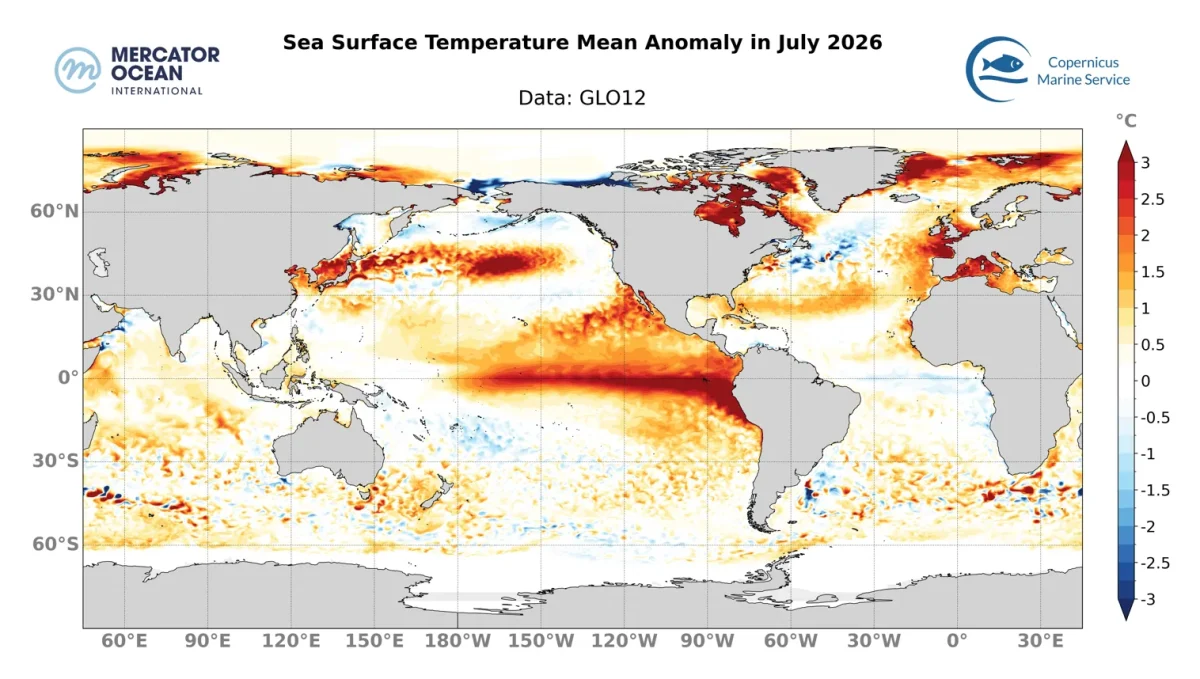
Average sea surface temperatures in July 2026 across the global ocean compared to the 30-year period between 1993 and 2022. The western equatorial Pacific experienced exceptionally high temperatures, ranging from 2°C to 3°C above average, marking the intensification of El Niño. Temperatures were also above average in the North Atlantic, the Arctic Ocean and North Pacific. Calculated using daily data from Mercator Ocean International’s GLO12 analysis and forecasting system for 2026. Credit: European Union, Copernicus Marine Service Data 2026 © Mercator Ocean.
Two things were notable about the presentation: the first was just how much warmer average temperatures are lately compared to what salmon are used to, and the second was that, with marine heatwaves already sitting off the coast and an El Niño forecast to build on top of them, they could go much higher still. In short, nobody watching that presentation was under any illusion about the tough road ahead for our salmon. In the end, the scientists outlined a challenging environmental landscape that is expected to result in average to below-average marine survival for Pacific salmon returning in 2026.
But few forecast how far 2026’s wild salmon harvest would fall. Russia has landed less than half of its preseason forecast, Alaska is well short of its own, and seafood supplier Tradex Foods says the year could rank among the weakest global harvests in modern history. Scientists point to warmer North Pacific waters as a likely major factor, a sign of what may be in store for wild salmon as ocean temperatures push further beyond the range they evolved in.
And as has been seen on the Skeena River the last few years, warmer-than-normal temperatures in freshwater can stress returning salmon, leading to deadly disease outbreaks.
DFO management, responding to their client harvesters from every sector, has been both slow and reluctant to adjust to the new normal.
The response on the Fraser
When it comes to managing major populations like Fraser sockeye, DFO’s fisheries managers do not just eyeball the environmental conditions facing salmon and make tweaks to their harvest plans to bring them in line with “average to below average” expectations of salmon abundance. Instead, a sophisticated response, made by a binational team of managers and experts, is developed and applied to forecast returns. For example, in 2026 temperatures on the Fraser were forecast to be higher. In response, DFO and the Pacific Salmon Commission’s Fraser River Panel applied pre-season Management Adjustments (pMAs) to account for heat-related mortality on sockeye traveling upstream to their spawning grounds. Those management adjustments increased the number of fish that DFO managers were required to allow to swim upriver past the fish-counting facility at Mission, directly reducing the “Total Allowable Mortality” and harvestable surplus available for fishers to catch.
As it turns out, none of that mattered. The forecast returns did not materialize; yet another reminder that despite DFO’s best efforts, their forecasts are off the mark more often than not.
The management response for coho
Coho was a different story entirely. DFO increased the domestic exploitation rate limit for Interior Fraser coho from 3% to 7%. This widely supported policy change was implemented to permit higher harvest and incidental impacts across First Nations, commercial, and recreational fisheries.
Retention opportunities for coho opened early, and have not stopped. Creel survey data to date shows that cumulative retained coho catch from June through August was 42% above the five-year average. The large harvests and high rates of release mortality mean that recreational anglers will kill coho in numbers we have not seen in several decades. And it’s not over yet. Most Vancouver Island rivers are open with retention as high as four fish per day.
Every indicator suggests DFO’s forecasted coho returns were accurate. However, the overzealous harvest and unaccounted-for bycatch have taken a huge toll. And in places where a dry summer has carried into the fall, people are raising two questions: Did they leave enough fish? And, how long until we get enough water for them to spawn?
Throwing caution to the wind
Where I live, on the east coast of Vancouver Island, a robust harvest was given a green light due to pre-season expectations and stock assessments for the northern Strait of Georgia and Johnstone Strait. Specifically, the Quinsam (hatchery) and Black Creek (wild) indicator populations showed above-average smolt production and strong adult returns.
The east coast of Vancouver Island has always been a stronghold for coho. During last year’s return, there were so many coho they were spawning in the ditch beside my house. This year however—as forecast— the region is experiencing persistent low flows in the key waterways that the coho revival depends upon.
And it could well get worse. Around Thanksgiving, many of these creeks are bone dry—leaving fish stranded at river mouths, vulnerable to fishing pressure and predation from seals and sea lions. The operational low-flow forecasting system developed by the British Columbia River Forecast Centre shows that under a ‘minimum’ forecast scenario, coho attempting to spawn in most of the region’s rivers, creeks, and streams will be doing so in flow levels at 10% of their long-term mean average.
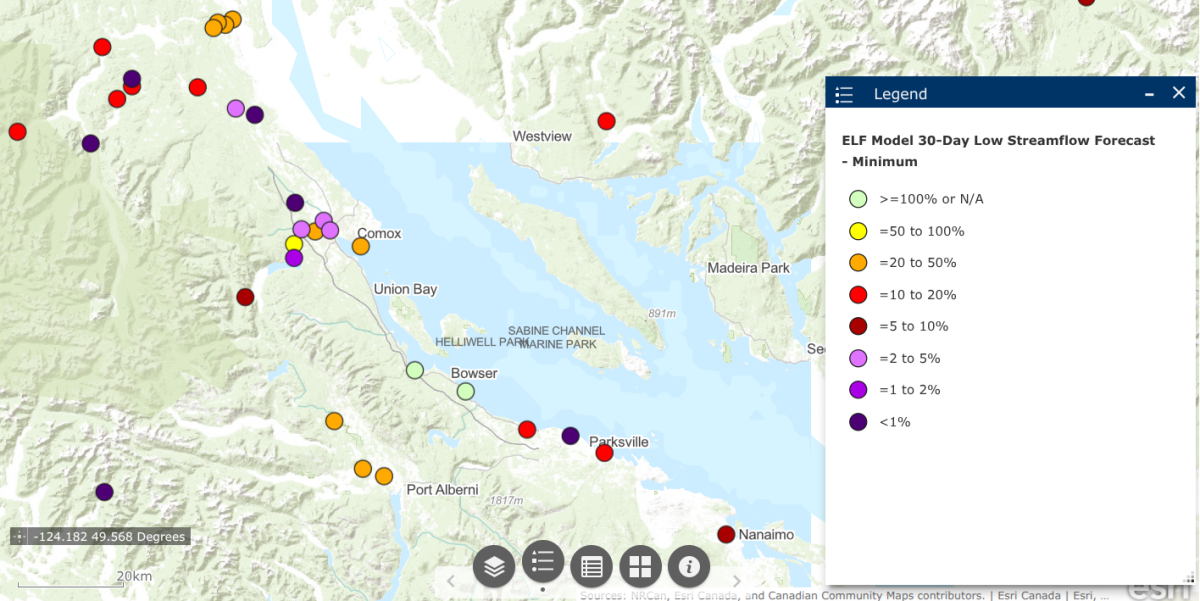
30-Day Low Streamflow Forecast
Next season’s forecast
El Niño is forecast to peak in late fall and early winter, and how it will play out across B.C.’s coast and watersheds is still uncertain. It’s arriving on top of a negative Pacific Decadal Oscillation (PDO), a longer-term pattern that usually leaves waters near the North American coast cooler than average. In practice, though, marine heatwaves have kept coastal waters warm all summer. So a very strong El Niño, a cool-leaning PDO, and lingering heatwaves are all pulling in different directions, and no one can say with confidence which will dominate this winter. Further out, very strong El Niños have historically collapsed quickly, often into La Niña (El Niño’s cool counterpart) bringing cooler-than-average water. Bigger swings, layered on a warming ocean: welcome to climate change.
What we do know is that this year’s management decisions were made in exactly the kind of climate that should invite caution rather than confidence. The Fraser sockeye response, built with U.S. partners through the Pacific Salmon Commission, shows DFO can develop sophisticated tools to hedge against forecasted risk — and that even those tools are only as good as the forecast underneath them, which this year missed badly. The coho decision took a different, harder-to-defend shape: a real exploitation increase, approved on genuinely strong pre-season indicators, without any apparent adjustment for the drought and heat risk the department’s own scientists had already flagged months earlier at that January briefing.
A more cautious approach would have opened rivers to angling as coho were counted arriving, rather than raising marine exploitation rates before anyone knew whether the streams they’re headed to would hold enough water to let them spawn. That’s not a call for zero harvest. It’s a call for spending a strong return in the place where DFO can actually see what’s happening in real time, instead of betting it on a season that, by DFO’s own account, was already expected to be difficult.
Share This Story!
It’s shaping up to be one of the strongest El Niño events ever recorded. Here’s what it means for B.C. salmon and how we manage them.
This past January, in the middle of a warm winter with insufficient snow in southern B.C., hundreds of people gathered online at the invitation of Canada’s Department of Fisheries and Oceans (DFO) to hear the annual salmon forecast. The forecast was delivered in two parts. First came the scientists who described the environmental conditions informing salmon returns in 2026. Then came the fishery managers with their run projections. With scientists confirming the return of warmer ocean temperatures across the North Pacific, the prospect of an El Niño was top of mind for all.
A quick refresher on El Niño
El Niño is the warm phase of a recurring Pacific Ocean cycle, showing up every few years when sea surface temperatures across the central and eastern tropical Pacific rise above normal. For B.C., that typically translates into a milder, drier winter, a thinner mountain snowpack, and warmer coastal waters. These conditions touch salmon at every stage of their life, from the amount of water in rearing streams to how much food is available once they reach the ocean. This year’s event isn’t a garden-variety one: The National Oceanic and Atmospheric Administration now puts the odds of it reaching “very strong” status above 90%, and a 75% chance it will exceed every El Niño on record since 1950, including the benchmark events of 1982–83, 1997–98 and 2015–16.
The forecast was for heat
For scientists, describing the environmental variables that salmon face is a huge job because British Columbia’s salmon rivers are spread across so many climatic zones, and because the fish coming home now went to sea between 2021 and 2024. The department has to examine a dizzying array of climate variables and food availability scenarios spread across four years to offer up some sort of conclusion about how the environment impacted spawning, rearing, feeding, and migration success during a salmon’s life—from the freshwater spawning gravel to the open Pacific Ocean and back again.
Average sea surface temperatures in July 2026 across the global ocean compared to the 30-year period between 1993 and 2022. The western equatorial Pacific experienced exceptionally high temperatures, ranging from 2°C to 3°C above average, marking the intensification of El Niño. Temperatures were also above average in the North Atlantic, the Arctic Ocean and North Pacific. Calculated using daily data from Mercator Ocean International’s GLO12 analysis and forecasting system for 2026. Credit: European Union, Copernicus Marine Service Data 2026 © Mercator Ocean.
Two things were notable about the presentation: the first was just how much warmer average temperatures are lately compared to what salmon are used to, and the second was that, with marine heatwaves already sitting off the coast and an El Niño forecast to build on top of them, they could go much higher still. In short, nobody watching that presentation was under any illusion about the tough road ahead for our salmon. In the end, the scientists outlined a challenging environmental landscape that is expected to result in average to below-average marine survival for Pacific salmon returning in 2026.
But few forecast how far 2026’s wild salmon harvest would fall. Russia has landed less than half of its preseason forecast, Alaska is well short of its own, and seafood supplier Tradex Foods says the year could rank among the weakest global harvests in modern history. Scientists point to warmer North Pacific waters as a likely major factor, a sign of what may be in store for wild salmon as ocean temperatures push further beyond the range they evolved in.
And as has been seen on the Skeena River the last few years, warmer-than-normal temperatures in freshwater can stress returning salmon, leading to deadly disease outbreaks.
DFO management, responding to their client harvesters from every sector, has been both slow and reluctant to adjust to the new normal.
The response on the Fraser
When it comes to managing major populations like Fraser sockeye, DFO’s fisheries managers do not just eyeball the environmental conditions facing salmon and make tweaks to their harvest plans to bring them in line with “average to below average” expectations of salmon abundance. Instead, a sophisticated response, made by a binational team of managers and experts, is developed and applied to forecast returns. For example, in 2026 temperatures on the Fraser were forecast to be higher. In response, DFO and the Pacific Salmon Commission’s Fraser River Panel applied pre-season Management Adjustments (pMAs) to account for heat-related mortality on sockeye traveling upstream to their spawning grounds. Those management adjustments increased the number of fish that DFO managers were required to allow to swim upriver past the fish-counting facility at Mission, directly reducing the “Total Allowable Mortality” and harvestable surplus available for fishers to catch.
As it turns out, none of that mattered. The forecast returns did not materialize; yet another reminder that despite DFO’s best efforts, their forecasts are off the mark more often than not.
The management response for coho
Coho was a different story entirely. DFO increased the domestic exploitation rate limit for Interior Fraser coho from 3% to 7%. This widely supported policy change was implemented to permit higher harvest and incidental impacts across First Nations, commercial, and recreational fisheries.
Retention opportunities for coho opened early, and have not stopped. Creel survey data to date shows that cumulative retained coho catch from June through August was 42% above the five-year average. The large harvests and high rates of release mortality mean that recreational anglers will kill coho in numbers we have not seen in several decades. And it’s not over yet. Most Vancouver Island rivers are open with retention as high as four fish per day.
Every indicator suggests DFO’s forecasted coho returns were accurate. However, the overzealous harvest and unaccounted-for bycatch have taken a huge toll. And in places where a dry summer has carried into the fall, people are raising two questions: Did they leave enough fish? And, how long until we get enough water for them to spawn?
Throwing caution to the wind
Where I live, on the east coast of Vancouver Island, a robust harvest was given a green light due to pre-season expectations and stock assessments for the northern Strait of Georgia and Johnstone Strait. Specifically, the Quinsam (hatchery) and Black Creek (wild) indicator populations showed above-average smolt production and strong adult returns.
The east coast of Vancouver Island has always been a stronghold for coho. During last year’s return, there were so many coho they were spawning in the ditch beside my house. This year however—as forecast— the region is experiencing persistent low flows in the key waterways that the coho revival depends upon.
And it could well get worse. Around Thanksgiving, many of these creeks are bone dry—leaving fish stranded at river mouths, vulnerable to fishing pressure and predation from seals and sea lions. The operational low-flow forecasting system developed by the British Columbia River Forecast Centre shows that under a ‘minimum’ forecast scenario, coho attempting to spawn in most of the region’s rivers, creeks, and streams will be doing so in flow levels at 10% of their long-term mean average.
30-Day Low Streamflow Forecast
Next season’s forecast
El Niño is forecast to peak in late fall and early winter, and how it will play out across B.C.’s coast and watersheds is still uncertain. It’s arriving on top of a negative Pacific Decadal Oscillation (PDO), a longer-term pattern that usually leaves waters near the North American coast cooler than average. In practice, though, marine heatwaves have kept coastal waters warm all summer. So a very strong El Niño, a cool-leaning PDO, and lingering heatwaves are all pulling in different directions, and no one can say with confidence which will dominate this winter. Further out, very strong El Niños have historically collapsed quickly, often into La Niña (El Niño’s cool counterpart) bringing cooler-than-average water. Bigger swings, layered on a warming ocean: welcome to climate change.
What we do know is that this year’s management decisions were made in exactly the kind of climate that should invite caution rather than confidence. The Fraser sockeye response, built with U.S. partners through the Pacific Salmon Commission, shows DFO can develop sophisticated tools to hedge against forecasted risk — and that even those tools are only as good as the forecast underneath them, which this year missed badly. The coho decision took a different, harder-to-defend shape: a real exploitation increase, approved on genuinely strong pre-season indicators, without any apparent adjustment for the drought and heat risk the department’s own scientists had already flagged months earlier at that January briefing.
A more cautious approach would have opened rivers to angling as coho were counted arriving, rather than raising marine exploitation rates before anyone knew whether the streams they’re headed to would hold enough water to let them spawn. That’s not a call for zero harvest. It’s a call for spending a strong return in the place where DFO can actually see what’s happening in real time, instead of betting it on a season that, by DFO’s own account, was already expected to be difficult.
Share This Story!
It’s shaping up to be one of the strongest El Niño events ever recorded. Here’s what it means for B.C. salmon and how we manage them.
This past January, in the middle of a warm winter with insufficient snow in southern B.C., hundreds of people gathered online at the invitation of Canada’s Department of Fisheries and Oceans (DFO) to hear the annual salmon forecast. The forecast was delivered in two parts. First came the scientists who described the environmental conditions informing salmon returns in 2026. Then came the fishery managers with their run projections. With scientists confirming the return of warmer ocean temperatures across the North Pacific, the prospect of an El Niño was top of mind for all.
A quick refresher on El Niño
El Niño is the warm phase of a recurring Pacific Ocean cycle, showing up every few years when sea surface temperatures across the central and eastern tropical Pacific rise above normal. For B.C., that typically translates into a milder, drier winter, a thinner mountain snowpack, and warmer coastal waters. These conditions touch salmon at every stage of their life, from the amount of water in rearing streams to how much food is available once they reach the ocean. This year’s event isn’t a garden-variety one: The National Oceanic and Atmospheric Administration now puts the odds of it reaching “very strong” status above 90%, and a 75% chance it will exceed every El Niño on record since 1950, including the benchmark events of 1982–83, 1997–98 and 2015–16.
The forecast was for heat
For scientists, describing the environmental variables that salmon face is a huge job because British Columbia’s salmon rivers are spread across so many climatic zones, and because the fish coming home now went to sea between 2021 and 2024. The department has to examine a dizzying array of climate variables and food availability scenarios spread across four years to offer up some sort of conclusion about how the environment impacted spawning, rearing, feeding, and migration success during a salmon’s life—from the freshwater spawning gravel to the open Pacific Ocean and back again.
Average sea surface temperatures in July 2026 across the global ocean compared to the 30-year period between 1993 and 2022. The western equatorial Pacific experienced exceptionally high temperatures, ranging from 2°C to 3°C above average, marking the intensification of El Niño. Temperatures were also above average in the North Atlantic, the Arctic Ocean and North Pacific. Calculated using daily data from Mercator Ocean International’s GLO12 analysis and forecasting system for 2026. Credit: European Union, Copernicus Marine Service Data 2026 © Mercator Ocean.
Two things were notable about the presentation: the first was just how much warmer average temperatures are lately compared to what salmon are used to, and the second was that, with marine heatwaves already sitting off the coast and an El Niño forecast to build on top of them, they could go much higher still. In short, nobody watching that presentation was under any illusion about the tough road ahead for our salmon. In the end, the scientists outlined a challenging environmental landscape that is expected to result in average to below-average marine survival for Pacific salmon returning in 2026.
But few forecast how far 2026’s wild salmon harvest would fall. Russia has landed less than half of its preseason forecast, Alaska is well short of its own, and seafood supplier Tradex Foods says the year could rank among the weakest global harvests in modern history. Scientists point to warmer North Pacific waters as a likely major factor, a sign of what may be in store for wild salmon as ocean temperatures push further beyond the range they evolved in.
And as has been seen on the Skeena River the last few years, warmer-than-normal temperatures in freshwater can stress returning salmon, leading to deadly disease outbreaks.
DFO management, responding to their client harvesters from every sector, has been both slow and reluctant to adjust to the new normal.
The response on the Fraser
When it comes to managing major populations like Fraser sockeye, DFO’s fisheries managers do not just eyeball the environmental conditions facing salmon and make tweaks to their harvest plans to bring them in line with “average to below average” expectations of salmon abundance. Instead, a sophisticated response, made by a binational team of managers and experts, is developed and applied to forecast returns. For example, in 2026 temperatures on the Fraser were forecast to be higher. In response, DFO and the Pacific Salmon Commission’s Fraser River Panel applied pre-season Management Adjustments (pMAs) to account for heat-related mortality on sockeye traveling upstream to their spawning grounds. Those management adjustments increased the number of fish that DFO managers were required to allow to swim upriver past the fish-counting facility at Mission, directly reducing the “Total Allowable Mortality” and harvestable surplus available for fishers to catch.
As it turns out, none of that mattered. The forecast returns did not materialize; yet another reminder that despite DFO’s best efforts, their forecasts are off the mark more often than not.
The management response for coho
Coho was a different story entirely. DFO increased the domestic exploitation rate limit for Interior Fraser coho from 3% to 7%. This widely supported policy change was implemented to permit higher harvest and incidental impacts across First Nations, commercial, and recreational fisheries.
Retention opportunities for coho opened early, and have not stopped. Creel survey data to date shows that cumulative retained coho catch from June through August was 42% above the five-year average. The large harvests and high rates of release mortality mean that recreational anglers will kill coho in numbers we have not seen in several decades. And it’s not over yet. Most Vancouver Island rivers are open with retention as high as four fish per day.
Every indicator suggests DFO’s forecasted coho returns were accurate. However, the overzealous harvest and unaccounted-for bycatch have taken a huge toll. And in places where a dry summer has carried into the fall, people are raising two questions: Did they leave enough fish? And, how long until we get enough water for them to spawn?
Throwing caution to the wind
Where I live, on the east coast of Vancouver Island, a robust harvest was given a green light due to pre-season expectations and stock assessments for the northern Strait of Georgia and Johnstone Strait. Specifically, the Quinsam (hatchery) and Black Creek (wild) indicator populations showed above-average smolt production and strong adult returns.
The east coast of Vancouver Island has always been a stronghold for coho. During last year’s return, there were so many coho they were spawning in the ditch beside my house. This year however—as forecast— the region is experiencing persistent low flows in the key waterways that the coho revival depends upon.
And it could well get worse. Around Thanksgiving, many of these creeks are bone dry—leaving fish stranded at river mouths, vulnerable to fishing pressure and predation from seals and sea lions. The operational low-flow forecasting system developed by the British Columbia River Forecast Centre shows that under a ‘minimum’ forecast scenario, coho attempting to spawn in most of the region’s rivers, creeks, and streams will be doing so in flow levels at 10% of their long-term mean average.
30-Day Low Streamflow Forecast
Next season’s forecast
El Niño is forecast to peak in late fall and early winter, and how it will play out across B.C.’s coast and watersheds is still uncertain. It’s arriving on top of a negative Pacific Decadal Oscillation (PDO), a longer-term pattern that usually leaves waters near the North American coast cooler than average. In practice, though, marine heatwaves have kept coastal waters warm all summer. So a very strong El Niño, a cool-leaning PDO, and lingering heatwaves are all pulling in different directions, and no one can say with confidence which will dominate this winter. Further out, very strong El Niños have historically collapsed quickly, often into La Niña (El Niño’s cool counterpart) bringing cooler-than-average water. Bigger swings, layered on a warming ocean: welcome to climate change.
What we do know is that this year’s management decisions were made in exactly the kind of climate that should invite caution rather than confidence. The Fraser sockeye response, built with U.S. partners through the Pacific Salmon Commission, shows DFO can develop sophisticated tools to hedge against forecasted risk — and that even those tools are only as good as the forecast underneath them, which this year missed badly. The coho decision took a different, harder-to-defend shape: a real exploitation increase, approved on genuinely strong pre-season indicators, without any apparent adjustment for the drought and heat risk the department’s own scientists had already flagged months earlier at that January briefing.
A more cautious approach would have opened rivers to angling as coho were counted arriving, rather than raising marine exploitation rates before anyone knew whether the streams they’re headed to would hold enough water to let them spawn. That’s not a call for zero harvest. It’s a call for spending a strong return in the place where DFO can actually see what’s happening in real time, instead of betting it on a season that, by DFO’s own account, was already expected to be difficult.
Share This Story!