Each week, Watershed Watch’s fisheries advisor Greg Taylor will share his expert insights on what’s happening in B.C.’s salmon fisheries. With decades of experience in the industry, Greg offers a blend of observations, analysis, and personal perspective.
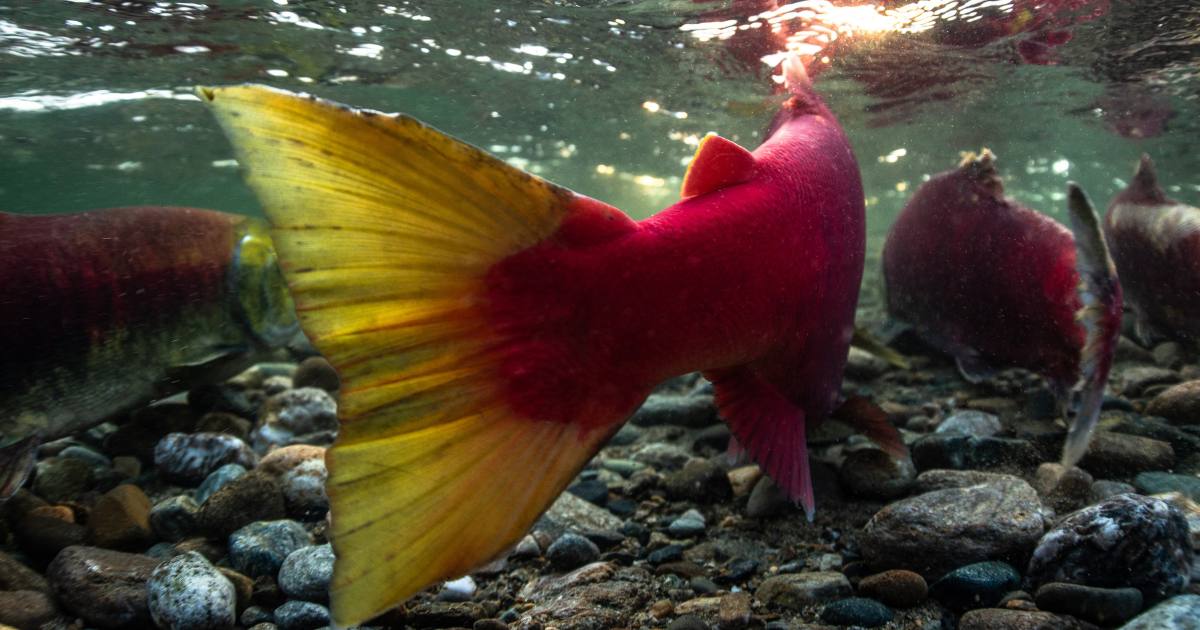
Feature image credit: Ronald Gockel
This will be my final regular update for a month or more. I will wait for the chum season to be well underway before providing my fellow lovers of all things salmon with another update.
But before beginning this update, please stand with me and raise a toast to the folks at the Marine Conservation Caucus (MCC), led by Watershed Watch Salmon Society, SkeenaWild Conservation Trust and Raincoast Conservation Foundation, for standing up for the charter patrol personnel around the coast. Our charter patrol personnel, AKA creekwalkers, are the people who are the ‘pointy end of the stick’ when it comes to monitoring and assessing our salmon returns.
You have read several times in my recaps that Stan Hutchings and Karen Hansen’s contract in Area 6 was first delayed, then cut short without warning. It turns out this was happening around our coast: Charter patrol people not getting their usual contracts or having them abruptly terminated in the midst of the salmon spawning season.
After members of the MCC wrote several letters, initiated a media campaign, then had meetings with senior DFO officials, most charter patrol people’s contracts were renewed, sometimes for not as long as in the past, but at least sufficient to provide reasonable coverage for the duration of the 2025 spawning season. Unfortunately, DFO was not making any commitments for 2026 or beyond. (Go here to send your email today, calling on federal decision-makers to fund future monitoring.)
Who caught what in the summer of 2025
This is a summary table of the estimated catches by gear type and country to the end of Canada’s summer salmon fisheries.

Summer Fisheries Table
Click image to zoom
Please note that Alaskan catch estimates are best guesses based on historical Alaskan interceptions of B.C. salmon along with some information produced by the Nisga’a Lisims’ Fisheries Department and Alaska’s Department of Fish and Game.
The United States provides no information on the number of salmon it catches in southern Fraser Panel-managed waters other than sockeye and pinks, which is why I haven’t recorded any of the B.C. chinooks and coho they are known to catch.
Also note that south coast recreational catches/discards only capture those areas and months that we have some information for. The fishery has been ongoing through the winter, spring, and summer of 2025, but the only information available is from the limited catch monitoring DFO has had in place for some areas in June and July. Therefore, this should not be read as an estimate of the actual number of chinook and coho caught in southern BC. The actual number could be double what I have shown. This would make it the largest domestic mixed stock marine fishery by far, other than the Area 3 pink salmon fishery.
Finally, little credence should be given to recreational or commercial discard estimates, nor should those estimates be used as evidence of how many discarded fish survive to spawn. The lack of verifiable data on either renders the information provided by DFO suspect.
In summary, we all think, based on our ongoing belief, founded on our collective history, that the marine B.C. commercial fishery harvests the largest proportion of salmon in B.C. But if you remove the 1.2 million pink salmon the seine fleet caught in Area 3, the largest harvests of Canadian salmon in 2025 were caught by the United States, the recreational fishery, and the Indigenous commercial fishery (largely upriver).
One would be forgiven for asking, ‘Isn’t the Canada/US Salmon Treaty supposed to balance each country’s interceptions of each other’s salmon?’ It is, but what this table does not capture is that a high proportion of the Canadian recreational catch of chinook and coho is of US origin. It will be interesting to see a full accounting of the 2025 catch when it comes out some months from now in Pacific Salmon Treaty meetings.
Below is a table of estimated in-season run sizes for both target and bycatch species/stocks.

A table of estimated in-season run sizes for both target and bycatch species/stocks.
Click image to zoom
Ongoing Fisheries
The only significant ongoing fisheries are the Lake Babine Nation sockeye fishery north of Burns Lake on Babine Lake, the Barkley Sound chinook fishery targeting enhanced Robertson Creek chinook, and the south coast recreational fishery.
Fraser River water temperatures remain well above normal for this time of year and are raising concerns that we could see increasing in-river mortality. Several such observations have already been reported for the Early-Summer stock group. The US is not planning any further fisheries as the bulk of the pink return is now in the river.
I hope you all enjoyed your legally-sourced B.C. salmon this year. The chum season is on the horizon, and a fresh chum is one of my favourite fresh salmon: mild and flavourful.
Take care all.
Read Previous Weekly Updates
Share This Story!
Each week, Watershed Watch’s fisheries advisor Greg Taylor will share his expert insights on what’s happening in B.C.’s salmon fisheries. With decades of experience in the industry, Greg offers a blend of observations, analysis, and personal perspective.
Feature image credit: Ronald Gockel
This will be my final regular update for a month or more. I will wait for the chum season to be well underway before providing my fellow lovers of all things salmon with another update.
But before beginning this update, please stand with me and raise a toast to the folks at the Marine Conservation Caucus (MCC), led by Watershed Watch Salmon Society, SkeenaWild Conservation Trust and Raincoast Conservation Foundation, for standing up for the charter patrol personnel around the coast. Our charter patrol personnel, AKA creekwalkers, are the people who are the ‘pointy end of the stick’ when it comes to monitoring and assessing our salmon returns.
You have read several times in my recaps that Stan Hutchings and Karen Hansen’s contract in Area 6 was first delayed, then cut short without warning. It turns out this was happening around our coast: Charter patrol people not getting their usual contracts or having them abruptly terminated in the midst of the salmon spawning season.
After members of the MCC wrote several letters, initiated a media campaign, then had meetings with senior DFO officials, most charter patrol people’s contracts were renewed, sometimes for not as long as in the past, but at least sufficient to provide reasonable coverage for the duration of the 2025 spawning season. Unfortunately, DFO was not making any commitments for 2026 or beyond. (Go here to send your email today, calling on federal decision-makers to fund future monitoring.)
Who caught what in the summer of 2025
This is a summary table of the estimated catches by gear type and country to the end of Canada’s summer salmon fisheries.
Summer Fisheries Table
Click image to zoom
Please note that Alaskan catch estimates are best guesses based on historical Alaskan interceptions of B.C. salmon along with some information produced by the Nisga’a Lisims’ Fisheries Department and Alaska’s Department of Fish and Game.
The United States provides no information on the number of salmon it catches in southern Fraser Panel-managed waters other than sockeye and pinks, which is why I haven’t recorded any of the B.C. chinooks and coho they are known to catch.
Also note that south coast recreational catches/discards only capture those areas and months that we have some information for. The fishery has been ongoing through the winter, spring, and summer of 2025, but the only information available is from the limited catch monitoring DFO has had in place for some areas in June and July. Therefore, this should not be read as an estimate of the actual number of chinook and coho caught in southern BC. The actual number could be double what I have shown. This would make it the largest domestic mixed stock marine fishery by far, other than the Area 3 pink salmon fishery.
Finally, little credence should be given to recreational or commercial discard estimates, nor should those estimates be used as evidence of how many discarded fish survive to spawn. The lack of verifiable data on either renders the information provided by DFO suspect.
In summary, we all think, based on our ongoing belief, founded on our collective history, that the marine B.C. commercial fishery harvests the largest proportion of salmon in B.C. But if you remove the 1.2 million pink salmon the seine fleet caught in Area 3, the largest harvests of Canadian salmon in 2025 were caught by the United States, the recreational fishery, and the Indigenous commercial fishery (largely upriver).
One would be forgiven for asking, ‘Isn’t the Canada/US Salmon Treaty supposed to balance each country’s interceptions of each other’s salmon?’ It is, but what this table does not capture is that a high proportion of the Canadian recreational catch of chinook and coho is of US origin. It will be interesting to see a full accounting of the 2025 catch when it comes out some months from now in Pacific Salmon Treaty meetings.
Below is a table of estimated in-season run sizes for both target and bycatch species/stocks.
A table of estimated in-season run sizes for both target and bycatch species/stocks.
Click image to zoom
Ongoing Fisheries
The only significant ongoing fisheries are the Lake Babine Nation sockeye fishery north of Burns Lake on Babine Lake, the Barkley Sound chinook fishery targeting enhanced Robertson Creek chinook, and the south coast recreational fishery.
Fraser River water temperatures remain well above normal for this time of year and are raising concerns that we could see increasing in-river mortality. Several such observations have already been reported for the Early-Summer stock group. The US is not planning any further fisheries as the bulk of the pink return is now in the river.
I hope you all enjoyed your legally-sourced B.C. salmon this year. The chum season is on the horizon, and a fresh chum is one of my favourite fresh salmon: mild and flavourful.
Take care all.
Read Previous Weekly Updates
Share This Story!
Each week, Watershed Watch’s fisheries advisor Greg Taylor will share his expert insights on what’s happening in B.C.’s salmon fisheries. With decades of experience in the industry, Greg offers a blend of observations, analysis, and personal perspective.
Feature image credit: Ronald Gockel
This will be my final regular update for a month or more. I will wait for the chum season to be well underway before providing my fellow lovers of all things salmon with another update.
But before beginning this update, please stand with me and raise a toast to the folks at the Marine Conservation Caucus (MCC), led by Watershed Watch Salmon Society, SkeenaWild Conservation Trust and Raincoast Conservation Foundation, for standing up for the charter patrol personnel around the coast. Our charter patrol personnel, AKA creekwalkers, are the people who are the ‘pointy end of the stick’ when it comes to monitoring and assessing our salmon returns.
You have read several times in my recaps that Stan Hutchings and Karen Hansen’s contract in Area 6 was first delayed, then cut short without warning. It turns out this was happening around our coast: Charter patrol people not getting their usual contracts or having them abruptly terminated in the midst of the salmon spawning season.
After members of the MCC wrote several letters, initiated a media campaign, then had meetings with senior DFO officials, most charter patrol people’s contracts were renewed, sometimes for not as long as in the past, but at least sufficient to provide reasonable coverage for the duration of the 2025 spawning season. Unfortunately, DFO was not making any commitments for 2026 or beyond. (Go here to send your email today, calling on federal decision-makers to fund future monitoring.)
Who caught what in the summer of 2025
This is a summary table of the estimated catches by gear type and country to the end of Canada’s summer salmon fisheries.
Summer Fisheries Table
Click image to zoom
Please note that Alaskan catch estimates are best guesses based on historical Alaskan interceptions of B.C. salmon along with some information produced by the Nisga’a Lisims’ Fisheries Department and Alaska’s Department of Fish and Game.
The United States provides no information on the number of salmon it catches in southern Fraser Panel-managed waters other than sockeye and pinks, which is why I haven’t recorded any of the B.C. chinooks and coho they are known to catch.
Also note that south coast recreational catches/discards only capture those areas and months that we have some information for. The fishery has been ongoing through the winter, spring, and summer of 2025, but the only information available is from the limited catch monitoring DFO has had in place for some areas in June and July. Therefore, this should not be read as an estimate of the actual number of chinook and coho caught in southern BC. The actual number could be double what I have shown. This would make it the largest domestic mixed stock marine fishery by far, other than the Area 3 pink salmon fishery.
Finally, little credence should be given to recreational or commercial discard estimates, nor should those estimates be used as evidence of how many discarded fish survive to spawn. The lack of verifiable data on either renders the information provided by DFO suspect.
In summary, we all think, based on our ongoing belief, founded on our collective history, that the marine B.C. commercial fishery harvests the largest proportion of salmon in B.C. But if you remove the 1.2 million pink salmon the seine fleet caught in Area 3, the largest harvests of Canadian salmon in 2025 were caught by the United States, the recreational fishery, and the Indigenous commercial fishery (largely upriver).
One would be forgiven for asking, ‘Isn’t the Canada/US Salmon Treaty supposed to balance each country’s interceptions of each other’s salmon?’ It is, but what this table does not capture is that a high proportion of the Canadian recreational catch of chinook and coho is of US origin. It will be interesting to see a full accounting of the 2025 catch when it comes out some months from now in Pacific Salmon Treaty meetings.
Below is a table of estimated in-season run sizes for both target and bycatch species/stocks.
A table of estimated in-season run sizes for both target and bycatch species/stocks.
Click image to zoom
Ongoing Fisheries
The only significant ongoing fisheries are the Lake Babine Nation sockeye fishery north of Burns Lake on Babine Lake, the Barkley Sound chinook fishery targeting enhanced Robertson Creek chinook, and the south coast recreational fishery.
Fraser River water temperatures remain well above normal for this time of year and are raising concerns that we could see increasing in-river mortality. Several such observations have already been reported for the Early-Summer stock group. The US is not planning any further fisheries as the bulk of the pink return is now in the river.
I hope you all enjoyed your legally-sourced B.C. salmon this year. The chum season is on the horizon, and a fresh chum is one of my favourite fresh salmon: mild and flavourful.
Take care all.
Read Previous Weekly Updates
Share This Story!